Year 5 · English · Literature · Book Week 2026 · Free Printable
Year 5 Point of View Worksheet
Challenge Year 5 students to compare viewpoints and explain how the information available to a narrator can influence the reader's response to characters and events.
Worksheet Preview
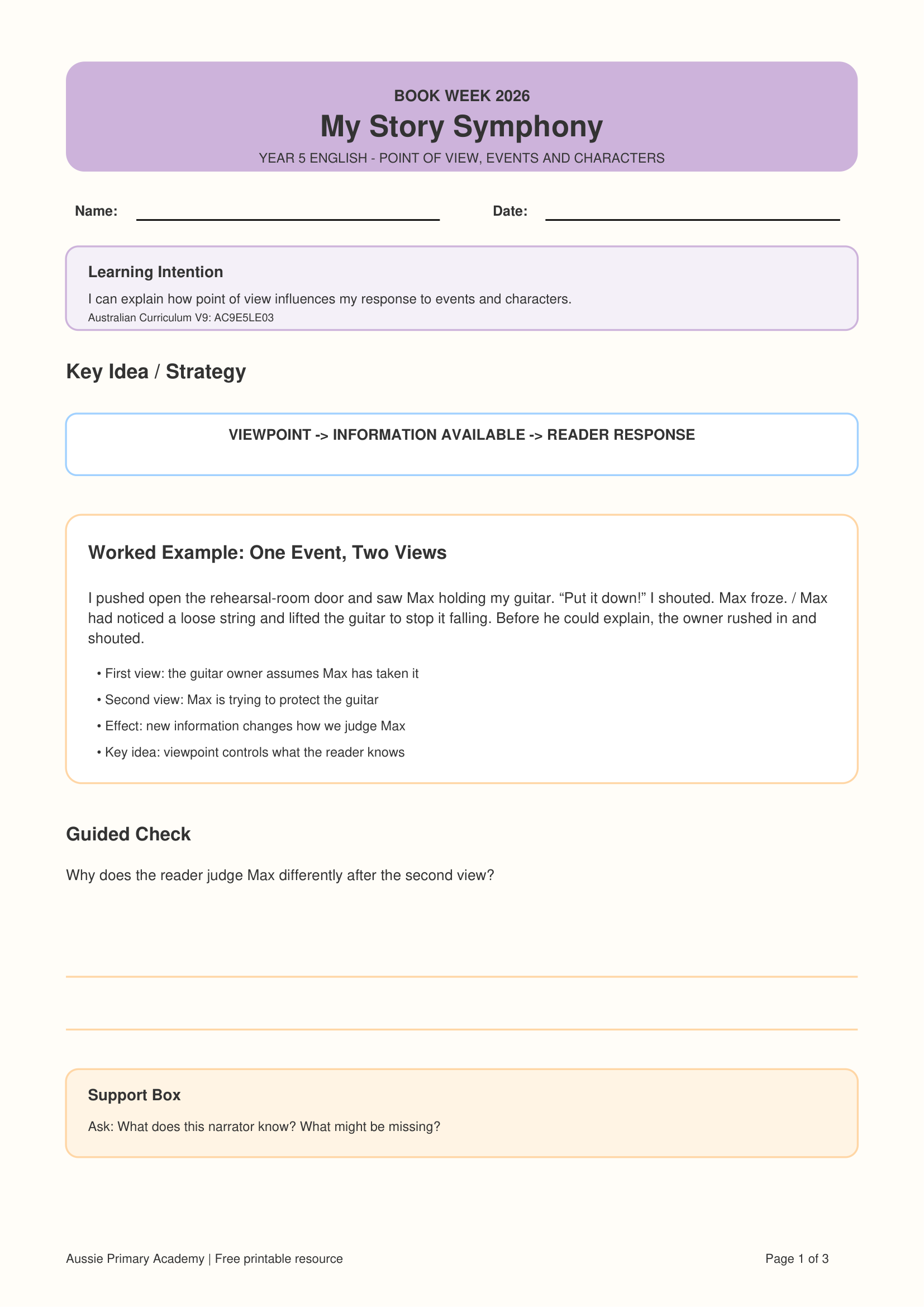
Preview of the first page · Full 3-page PDF includes student activities, answer key and teaching support
About This Year 5 Point of View Worksheet
This Year 5 English resource helps students explore how point of view changes the way a story is understood. Students compare perspectives and consider what each narrator or character knows.
They separate evidence from assumptions and explain how new information can change a reader's judgement of a character or event.
It is part of the My Story Symphony – Book Week 2026 collection from Aussie Primary Academy.
Learning Intention
“I can explain how point of view influences my response to events and characters.”
Australian Curriculum V9
AC9E5LE03
Supports students to recognise that point of view influences how readers interpret and respond to events and characters.
Aussie Primary Academy is an independent publisher and is not endorsed by ACARA.
Skills Practised
- Recognising point of view
- Comparing perspectives
- Identifying what a narrator knows
- Separating evidence from assumption
- Interpreting character behaviour
- Supporting responses with text evidence
Teacher / Parent Tip
Create two columns: “What the narrator knows” and “What the reader later learns.”
Ask students whether the new information changes their opinion of a character and require them to explain why.
What's Included
- Year 5 point-of-view learning intention
- Perspective and narrator explanation
- Short literary reading tasks
- Two-viewpoint comparison
- Evidence versus assumption activity
- Character interpretation questions
- Evidence-based written responses
- Answer key
- Teacher and parent support
Differentiation
Support: Read the viewpoints separately and highlight exactly what each narrator or character knows.
Core: Students compare the viewpoints and explain how each perspective influences their interpretation.
Extend: Ask students to rewrite part of the scene from a third character's viewpoint and identify which information changes.
Why This Helps Readers
Point-of-view analysis develops critical reading. Students discover that their interpretation of an event or character can change depending on who tells the story, what that person knows and what information is withheld.
How to Use This Worksheet
- Whole class: Compare how two people might describe the same event differently.
- Guided reading: Highlight what each viewpoint reveals and what it leaves unknown.
- Independent practice: Students compare perspectives and justify their interpretation with evidence.
- Writing connection: Rewrite a short event from another character's perspective.
Frequently Asked Questions
What is point of view?
Point of view is the perspective from which events are presented. Different viewpoints can give readers different information about the same character or event.
Why compare two viewpoints?
Comparing viewpoints helps students notice how access to different information can change interpretation and judgement.
Is an answer key included?
Yes. The resource includes suggested answers and teaching support.
Is this worksheet free?
Yes. The PDF is free to download and print for learning use.
Free Book Week Bonus
Continue with My Book Week Reading Adventure
Explore the free Foundation–Year 6 reading booklet with activities for story elements, characters, settings, vocabulary, creative response and book recommendations.
View the Free F–6 WorkbookExplore the Book Week Story Elements Collection
Choose another year level or continue through the collection.