Foundation · All Subjects
Free Foundation and Prep Worksheets for Australian Children
A practical guide to choosing and using free printable Maths, English, Reading, Writing, Phonics and Science worksheets during the first year of school.
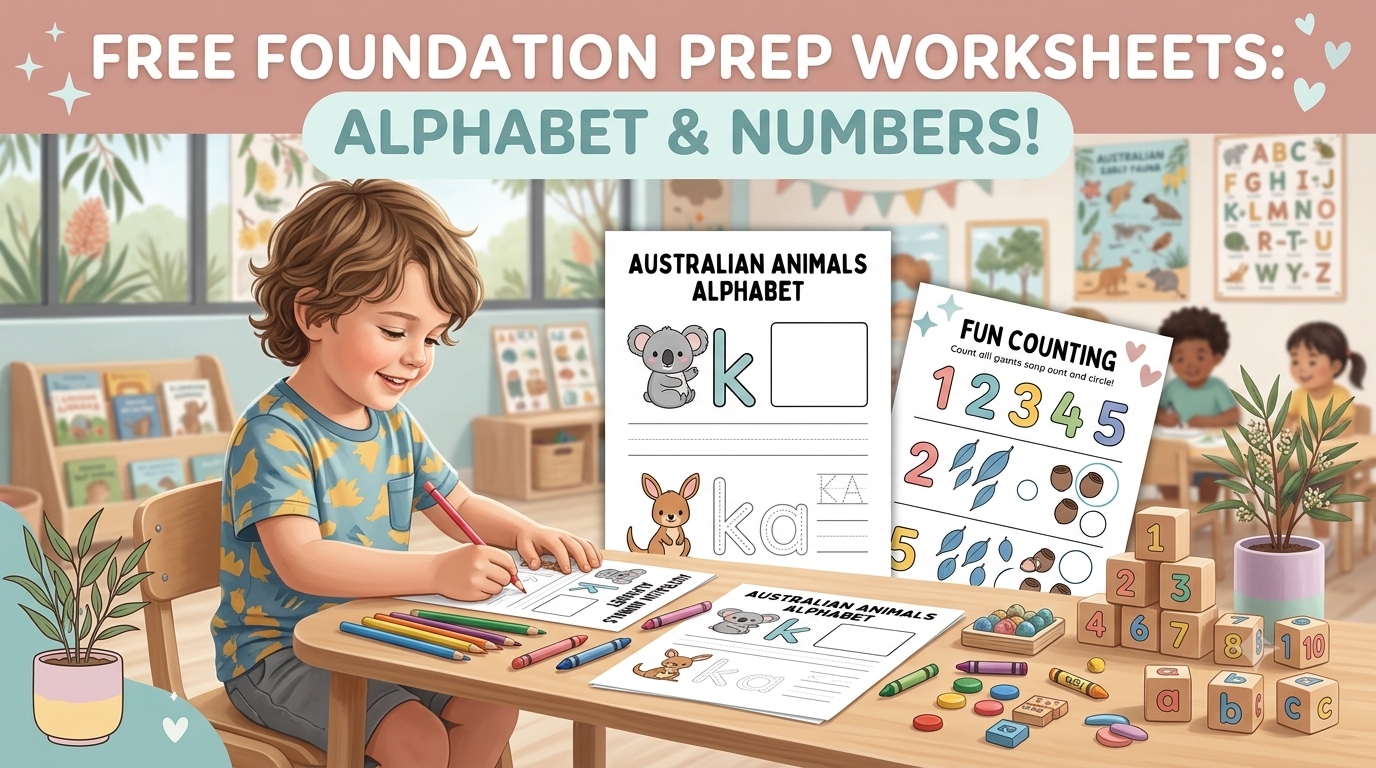
Starting school brings plenty of excitement, but it can also leave parents wondering what their child should practise at home. You may be looking for simple counting activities, early phonics practice or short reading tasks that support classroom learning without turning afternoons into another school day.
Aussie Primary Academy offers free printable Foundation worksheets for Australian families, teachers, tutors and homeschoolers. The collection includes Maths, English, Reading, Writing, Phonics and Science activities designed for focused, low-prep practice.
This guide explains what Foundation means, which early skills matter and how to use printable worksheets in a balanced, child-friendly way.
What Are Foundation and Prep in Australia?
The Australian Curriculum uses Foundation for the first year of school. However, the local name differs between Australian states and territories.
Victoria commonly calls the first year Foundation or Prep. New South Wales calls it Kindergarten, while Western Australia uses Pre-primary. Families may therefore search for Foundation worksheets, Prep worksheets, Kindergarten activities or first-year-of-school resources.
Before choosing a worksheet, check the skill and difficulty rather than relying only on the year-level label.
The Australian Curriculum Version 9.0 sets out learning from Foundation to Year 10. Schools and teachers use the curriculum flexibly and adjust learning to suit their students. A worksheet can provide useful extra practice, but it should not replace classroom teaching, play, conversation, movement or hands-on exploration.
What Skills Do Children Practise in Foundation?
Foundation learning builds the early knowledge children will use throughout primary school.
Children do not all develop at the same pace. Practice should match the individual child rather than become a race to complete Year 1 work early.
Common areas for gentle practice
- Recognising, naming and forming letters
- Hearing and working with sounds in spoken words
- Blending sounds to read simple words
- Reading short decodable sentences
- Speaking and writing simple ideas
- Counting, comparing and representing small collections
- Recognising patterns and common shapes
- Comparing length, mass and capacity informally
- Observing living things, materials and the world around them
Choose one clear goal at a time. A short worksheet on beginning sounds is usually more useful than a mixed page covering five unrelated skills.
Free Foundation Maths Worksheets
Build early number understanding through focused and practical activities.
Early Maths should help children understand quantities and relationships, not simply memorise answers.
Our Foundation Maths worksheets include activities for counting and comparing collections, subitising, part-part-whole thinking, addition within 10, repeating patterns, shapes and informal measurement. Popular options include the counting collections to 20 worksheet, subitising practice, and part-part-whole to 10.
When using a Maths worksheet, add real objects whenever possible. A child can count buttons before recording a number, build two parts of a group with blocks or compare the lengths of pencils before completing a measurement question.
If your child becomes stuck, reduce the number range or model one example together. Accuracy matters, but confidence and understanding matter more than completing every question.
Free English, Reading and Phonics Worksheets
Support alphabet knowledge, sound awareness and beginner reading.
Early literacy includes listening, speaking, phonological awareness, phonics, reading and writing. It is broader than tracing letters or memorising sight words.
Our Foundation English worksheets support alphabet knowledge, early word building, sight words and handwriting. Start with the free alphabet letter A to Z worksheet or sight words set 1.
The Foundation Phonics worksheets include rhyming, beginning sounds, letter sounds and blending simple consonant-vowel-consonant words. Try the beginning sounds worksheet or CVC blending and segmenting.
For children beginning to read, the Foundation Reading worksheets provide short decodable sentences, high-frequency word practice and simple comprehension activities. See the decodable sentences worksheet and sight words reading practice.
Parents can support the task by asking the child to point to the words, say the sounds and explain an answer aloud before writing.
A helpful prompt such as “What sound does this word begin with?” or “Can you find a clue in the sentence?” supports independence without creating pressure.
Free Foundation Writing Worksheets
Move from drawing and oral language towards first words and sentences.
Young children need many opportunities to talk, draw, experiment with letters and create meaning. Perfect spelling is not the goal of every early writing activity.
Our Foundation Writing worksheets include story sequencing, simple sentence writing, CVC words and short captions. Useful starting points are the CVC words and captions worksheet and sentence writing practice.
Before a child writes, invite them to say the sentence aloud. Count the words together, listen for beginning sounds and discuss where a capital letter and full stop belong.
Keep writing sessions short. If handwriting effort makes it difficult for the child to share ideas, let them dictate part of the response or take turns writing.
Free Foundation Science Worksheets
Encourage observation, curiosity and discussion about the natural world.
Foundation Science begins with curiosity and observation. Children can notice features of plants and animals, sort living and non-living things and describe what they discover using their senses.
The Foundation Science worksheets are most effective when paired with real experiences.
After completing a plant activity, look closely at a leaf or garden plant. After a five-senses task, discuss which senses were used during a walk, meal or classroom activity.
Science worksheets should encourage children to notice, compare, ask questions and explain—not merely copy facts.
How to Use Worksheets Without Overloading Your Child
One short, calm and purposeful activity is often enough.
- Choose the right level. Start with something the child can partly do.
- Keep sessions brief. Ten focused minutes can be more useful than a long session.
- Read instructions together. Foundation children may need adult support.
- Add play and real objects. Use counters, letters, drawings and movement.
- Stop when frustration rises. Return later or choose an easier task.
- Notice effort and strategies. Ask how the child worked something out.
Worksheets are particularly useful when you want targeted revision, a quiet follow-up activity or a quick way to see which part of a skill needs more support.
A few playful ideas beyond the worksheet:
- Count everyday objects together — carrots, spoons, steps on the stairs
- Say the first sound of household items out loud ("b for bed, b for ball")
- Let your child write letters in sand, flour or shaving foam instead of on paper — same skill, more fun
- Build simple AB patterns with socks, blocks or pieces of fruit
Related Worksheets
Free printable Foundation resources across subjects.
-
Foundation · Maths
Number
Counting to 20
Practise counting objects accurately and recognising numbers to 20.
Download Free Worksheet → -
Foundation · Phonics
-
Foundation · Phonics
CVC
CVC Blending & Segmenting
Put sounds together and break words into individual sounds.
Download Free Worksheet → -
Foundation · English
Alphabet
Alphabet Letter A to Z
Recognise and form letters of the alphabet.
Download Free Worksheet →
Explore More
Jump straight to the matching year hub, subject library or more guides.
-
Foundation · All
-
All Years · Worksheets
-
Blog · Guides
More Learning Guides
Practical teaching and parent guides with free printable links.
All Blog Guides →
You May Also Like
Related guides for Australian primary families and teachers.
-
Foundation · Maths
Maths · At Home
Foundation Maths: 10 Fun Ways to Learn at Home
Playful ways to help Prep/Foundation children build early maths confidence.
Read the Guide → -
Foundation–Year 1 · Phonics
Phonics · CVC
What are CVC Words? A Simple Guide for Parents
Learn what CVC words are and download free printable CVC worksheets.
Read the Guide → -
F–6 · Reading
Reading Skills Guide
How to Improve Your Child’s Reading Skills at Home
Simple strategies for reading confidence, vocabulary and comprehension.
Read the Guide →
Frequently Asked Questions
Are Foundation and Prep the same thing?
Foundation is the national curriculum year-level term, while local school-year names vary. Victoria commonly uses Foundation or Prep, NSW uses Kindergarten and WA uses Pre-primary.
Are these worksheets free?
Yes. The Foundation worksheets on Aussie Primary Academy are free to download and print, with no account required.
How often should a Foundation child use worksheets?
There is no fixed number that suits every child. Use short, purposeful sessions and balance worksheets with play, reading aloud, conversation, movement and hands-on learning.
Can teachers and homeschool families use these resources?
Yes. The worksheets can support classroom practice, tutoring and homeschool learning. They are supplementary resources rather than a complete teaching program.
Do all worksheets include answer guides?
Many worksheets include answer support, while some early-learning activities focus on tracing, drawing, matching or open responses. Check the individual PDF for what is included.
Keep Learning
Explore more free Australian primary worksheets, activities and teacher resources aligned to the Australian Curriculum.
Publisher note: Aussie Primary Academy is an independent educational publisher. Our resources are written to be Australian Curriculum-aligned and ACARA-aware, but they are not official ACARA products and are not endorsed by ACARA.