Foundation · Maths
Foundation Maths Worksheets Australia: 10 Fun Ways to Help Your Child Learn Maths at Home
Looking for free Foundation Maths worksheets in Australia? Discover 10 simple, playful ways to help your child build early maths confidence at home.
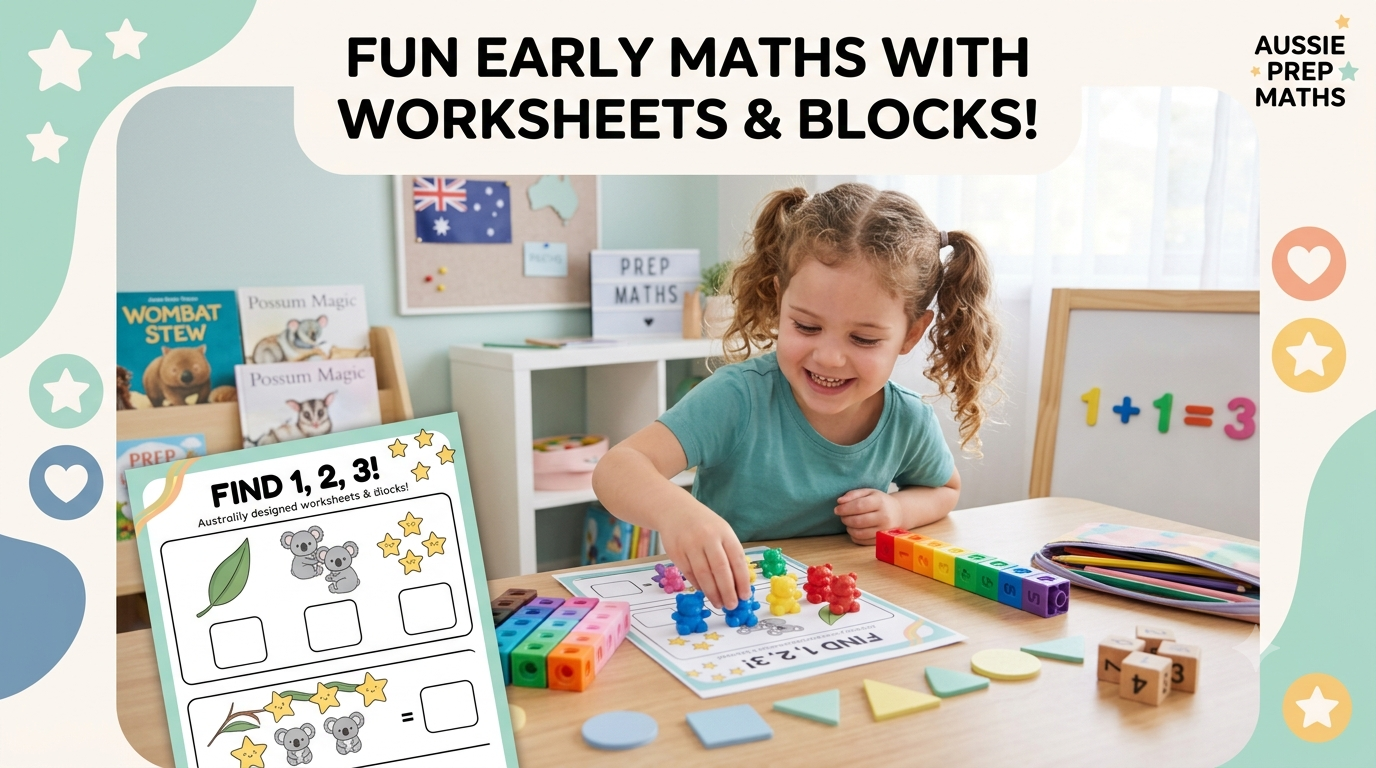
If your child has just started Prep or Foundation, you're probably wondering how to make maths enjoyable without turning your home into another classroom.
The good news is that young children learn best through play, short activities and lots of encouragement. You don't need expensive resources or hours of teaching experience. Even 10–15 minutes of fun maths practice each day can help children build confidence and develop strong number skills.
At Aussie Primary Academy, we create free printable Foundation Maths worksheets designed for Australian families, teachers and homeschoolers. Every worksheet is created to support learning outcomes aligned with the Australian Curriculum (Version 9.0).
Why Early Maths Matters
Confidence with numbers now makes later primary school easier.
The first years of school build the foundation for everything that comes later. Children who develop confidence with numbers early often find addition, subtraction, multiplication and problem solving much easier in later primary school.
Early maths isn't about memorising difficult sums. It's about learning to:
- Recognise numbers
- Count objects accurately
- Compare quantities
- Identify patterns
- Understand shapes
- Solve simple everyday problems
When children enjoy maths, they're more willing to keep trying—even when something feels challenging.
10 Simple Maths Activities You Can Do at Home
Everyday play, conversation and practical experiences that build early mathematical thinking.
1. Count Everything
Count toys, apples, socks, books or stairs. The more children count real objects, the stronger their number sense becomes.
Try this: Ask your child to count a group of objects, then check the answer by touching each object once.
For structured practice, try the Foundation counting to 20 worksheet or the counting and comparing quantities worksheet.
2. Play Number Hunts
Choose a number and ask your child to find it around the house. Examples include house numbers, clocks, calendars, food packets and books.
Try this: Choose one number and see how many times your child can find it during the day.
3. Sort Household Objects
Sort buttons, blocks or toys by colour, size, shape or type. Sorting develops early mathematical thinking.
Ask: How could we sort these objects in a different way?
Support this with the Foundation shapes: sort and create worksheet.
4. Build Patterns
Create simple patterns using shapes, objects or colours. Ask your child what comes next and explain how they know.
Try this: Make a repeating pattern with two objects, then invite your child to continue it.
Practise further with the Foundation repeating patterns worksheet.
5. Cook Together
Cooking naturally teaches counting, measuring, comparing and sequencing. Children love helping in the kitchen while practising maths without even realising it.
Ask: What do we need first? Which container holds more? How many pieces do we have?
Explore measuring ideas with the Foundation length, mass and capacity worksheet.
6. Play Dice Games
Dice games improve number recognition, counting on and comparing quantities.
Try this: Roll two dice and ask which number is greater. Older Foundation learners can count the dots on both dice.
Subitising (instantly recognising small quantities) is a key skill here — try the Foundation subitising worksheet.
7. Use Printable Worksheets
Short worksheet sessions help children practise skills they've already explored through play.
You can explore our free Foundation Maths worksheets and learning resources for extra practice, including the part-part-whole to 10 worksheet and the add and take-away to 10 worksheet.
8. Read Number Books
Many picture books introduce counting and early maths through stories that children enjoy.
Try this: Pause during the story and ask your child to count objects, notice numbers or predict what might happen next.
9. Ask Everyday Maths Questions
Ask questions like "Which pile has more?", "How many plates do we need?" or "What shape is this sign?".
Small conversations build mathematical thinking every day.
10. Celebrate Effort
Praise persistence rather than perfect answers. Children develop confidence when they know mistakes are part of learning.
Remember: The goal is to build confidence and curiosity, not to get every answer right immediately.
How Our Free Foundation Maths Worksheets Can Help
Our printable worksheets are designed to support early learners with activities such as number recognition, counting, tracing numbers, comparing quantities, simple patterns, shapes and early problem solving.
They're ideal for parents, classroom teachers, tutors and homeschool families.
Tips for Parents
Children don't need hours of maths practice. Instead, try:
- 10–15 minute sessions
- Regular praise
- Fun games
- Real-life maths activities
- One worksheet at a time
Consistency is much more important than long study sessions.
Common Early Number Misconceptions
Normal parts of learning to count — worth knowing rather than worrying about.
Reciting numbers isn't the same as understanding them. A child can count to 20 perfectly and still not grasp that the last number they say represents the total amount (called cardinality). Ask "how many?" after counting, not just "can you count to 20?"
Confusing similar-looking numbers. Mixing up 6 and 9, or writing 14 as 41, is extremely common at this age and isn't a sign of a problem — it usually resolves with more hands-on practice, not correction alone.
Relying on appearance over amount. Young children often judge "more" by how spread out objects look rather than actually counting them. Games that mix up spacing and arrangement help build true number sense.
Related Worksheets
Free printable Foundation Maths resources that pair well with this guide.
-
Foundation · Maths
Number
Counting to 20
Practise counting objects accurately and recognising numbers to 20.
Download Free Worksheet → -
Foundation · Maths
Number
Subitising
Instantly recognise small quantities without counting one by one.
Download Free Worksheet → -
Foundation · Maths
Patterns
Repeating Patterns
Create and continue simple repeating patterns with shapes and objects.
Download Free Worksheet → -
Foundation · Maths
Number
Part-Part-Whole to 10
Explore how numbers can be split and combined within 10.
Download Free Worksheet → -
Foundation · Maths
Number
Add and Take-Away to 10
Simple addition and subtraction practice within 10.
Download Free Worksheet → -
Foundation · Maths
Measurement
Length, Mass & Capacity
Compare and describe length, mass and capacity using everyday language.
Download Free Worksheet →
Explore More
Jump straight to the matching year hub, subject library or more guides.
-
Foundation · Maths
Explore Foundation Maths
All free printable Foundation Maths worksheets in one place.
Foundation Maths Hub → -
All Years · Maths
Explore Maths Worksheets
Browse the complete Maths collection across Foundation to Year 6.
Maths Subject Hub → -
Blog · Guides
You May Also Like
Related guides for Australian primary families and teachers.
-
Foundation · All Subjects
Foundation · Parent Guide
Free Foundation and Prep Worksheets for Australian Children
Key early-learning skills plus printable Maths, English, Phonics, Reading, Writing and Science resources.
Read the Guide → -
Foundation–Year 1 · Phonics
Phonics · CVC
What are CVC Words? A Simple Guide for Parents
Learn what CVC words are and download free printable CVC worksheets for Foundation and Year 1.
Read the Guide → -
Year 3 · Maths
Maths · Skills Guide
Best Year 3 Maths Worksheets for Australian Students
Place value, fractions, multiplication, money and measurement with free printable worksheets.
Read the Guide →
Frequently Asked Questions
Are these worksheets free?
Yes. Our printable Foundation Maths worksheets are free to download.
Are they suitable for Australian schools?
They are designed to support learning aligned with the Australian Curriculum (Version 9.0).
Can teachers use them?
Yes. Teachers, tutors and homeschool families are welcome to use our printable resources.
How often should my child practise?
Around 10–15 minutes most days is usually enough for young learners.
Keep Learning
Explore more free Australian primary worksheets, activities and teacher resources aligned to the Australian Curriculum.